A heart health check looks for the silent risks behind heart attacks and strokes, such as high blood pressure, raised cholesterol and early narrowing of the arteries, before they cause symptoms. Fortunately, in the UK you can have one free on the NHS from the age of 40, or privately from around £170. So, this guide explains every test, what to expect on the day and what each option costs.
The short answer
Free
NHS Health Check, aged 40 to 74 in England
£170 to £450
Heart basics within a private health check
£995 to £1,300
Heart health check at a private clinic, with ECG, echo and a specialist
£250 to £1,550
Heart CT scans, from a calcium score to a CT coronary angiogram
Chest pain, breathlessness or a racing heart right now? In that case, do not wait for a check. Call 999 for chest pain, or see your GP.
What is a heart health check?
A heart health check, sometimes called cardiovascular screening or heart disease screening, measures the things that raise your risk of a heart attack or stroke. Above all, it is designed for people who feel well. In other words, it screens for risk rather than diagnosing disease, so your GP or a cardiologist needs to follow up anything significant it finds.
For example, a basic check covers blood pressure, cholesterol, blood sugar and a risk score. By contrast, a more comprehensive heart check up adds tests of the heart itself, such as an ECG, an ultrasound of the heart or a CT scan of the heart arteries.
What does a heart check up include? The tests explained
Below are the tests you are most likely to be offered, from the simplest to the most detailed.
| Test | What it shows | Usually included in |
|---|---|---|
| Blood pressure | Whether the pressure in your arteries is too high, which is one of the biggest causes of heart attacks and strokes. | Every check |
| Cholesterol blood test | The fats in your blood that can build up inside the arteries. | Every check |
| Blood sugar (HbA1c) | Your average blood sugar, because diabetes damages the heart and blood vessels. | Most checks |
| Risk score | Your chance of a heart attack or stroke over the next ten years, calculated from your results and history. | Most checks |
| ECG | The heart's electrical activity and rhythm at the time of the test. | Private heart checks |
| Echocardiogram (echo) | An ultrasound of the heart, showing its pumping strength, chambers and valves. | Private heart checks |
| Exercise ECG | How your heart copes when it works harder, for example on a treadmill. | Some private checks |
| CT calcium score | Calcium in the heart arteries, which is therefore an early sign of fatty build-up. | Advanced checks |
| CT coronary angiogram | Detailed images of the heart arteries, showing where any narrowing is and how severe it is. | Advanced checks |
For more on what blood results mean, read our guide to what blood tests show.
Which heart tests matter most?
Of course, more tests do not always mean a better check. However, a few points help you judge what you need.
The basics do the most work
In fact, blood pressure, cholesterol and blood sugar, combined into a risk score, identify most people who need treatment.
A normal ECG is not the full story
After all, a resting ECG shows your heart at one moment. As a result, it can be normal even when the arteries are starting to narrow.
An echo looks at structure
On the other hand, an echocardiogram is useful for checking the heart muscle and valves, particularly if a murmur or breathlessness has been noticed.
A calcium score can settle doubt
In particular, for people at borderline risk, a CT calcium score shows whether build-up has actually started, which can change the advice you are given.
An angiogram shows the arteries in detail
A CT coronary angiogram pinpoints narrowing, so doctors usually reserve it for higher risk, symptoms or a strong family history.
How do I check if my heart is healthy?
Start by knowing your numbers. For example, a quick check at home is the free NHS Heart Age Test, and after that a blood pressure reading and a cholesterol test tell you most of what you need. Your doctor will then compare your results with these NHS guide levels for healthy adults. However, your own targets may differ, depending on your age, health and overall risk, so ask your doctor what yours should be.
Blood pressure
- High when 140/90 or above, measured at a clinic
- High when 135/85 or above, measured at home
Cholesterol
- First, total cholesterol below 5 mmol/L
- Second, non-HDL cholesterol below 4 mmol/L
- HDL, the "good" cholesterol, above 1.0 mmol/L for men and 1.2 mmol/L for women
What do they do for a heart health check?
First, here is what to expect. Whether you go through the NHS or a private clinic, the check generally follows a similar pattern.
- Questions about youFirst, you are asked about your age, lifestyle, medication and any family history of heart disease, stroke or diabetes.
- Simple measurementsNext, your height, weight, waist size and blood pressure, are measured, usually with a cuff on your upper arm.
- A blood testThen comes either a finger-prick test or a sample from your arm, to measure cholesterol and blood sugar. Therefore, follow any instructions about fasting beforehand.
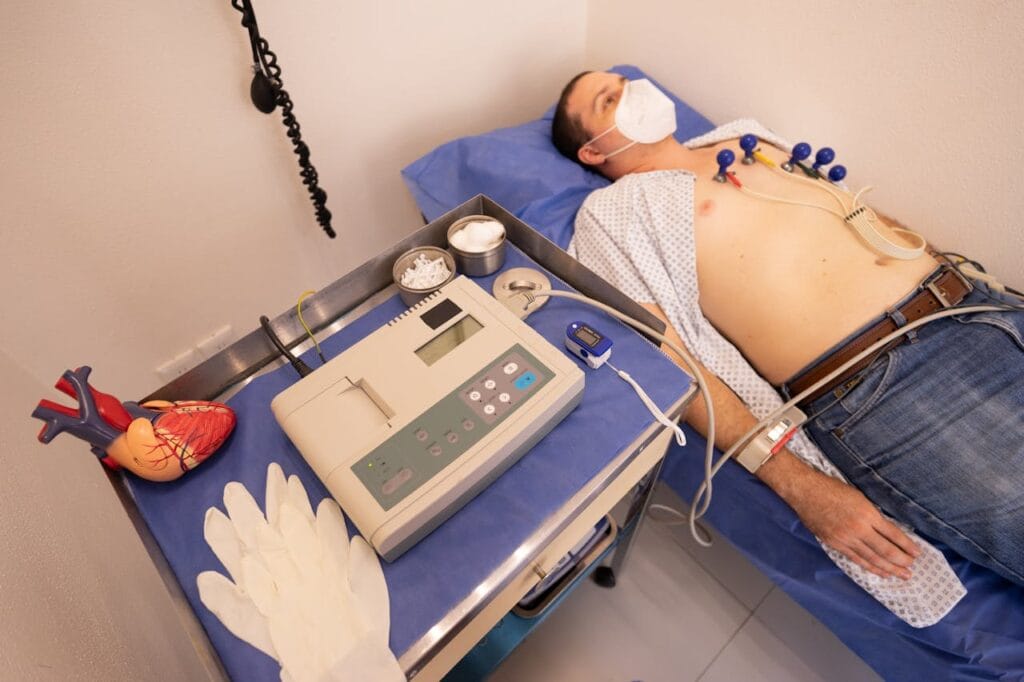
- Heart tests, at private checksFor instance, an ECG takes a few minutes with small sticky pads on your chest. Similarly, an echo is a painless ultrasound scan of your chest. Finally, CT scans take place in a scanner and may need an injection of dye.
- Your results explainedAt the end, a nurse, GP or cardiologist talks you through your numbers, your risk score and any next steps.
In most cases, an NHS Health Check takes 20 to 30 minutes. Meanwhile, most private heart checks are completed in a single visit, and appointments with several scans can take a few hours.
How can I get my heart health checked in the UK?
On the NHS
- If you live in England, are 40 to 74 and have no diagnosed heart, kidney or blood sugar condition or past stroke, expect an invitation to the free NHS Health Check once every five years
- Alternatively, if you have symptoms or a strong family history, see your GP, who can refer you for further tests
- Before anything else, though, try the free NHS Heart Age Test, for adults aged 30 to 95
Privately
- First of all, you can book a private heart health check without a GP referral
- Private clinics also offer anything from a basic check to a full day of heart imaging
- Then a doctor or cardiologist usually explains your results, often within days
- Finally, check whether the price includes the consultant's fee
How much does a private heart health check cost?
In comparison with packages, single tests are cheaper. These were typical self-pay prices in 2026. As a result of separate facility and consultant fees, the final bill can be higher than the headline price, so always ask what is included.
| Test or package | Typical price | Good to know |
|---|---|---|
| Resting ECG | £50 to £150 | Quick and widely available. |
| Echocardiogram | £250 to £500 | It is often paired with a consultation. |
| Exercise ECG | £250 to £500 | Usually, a cardiac physiologist supervises it. |
| CT calcium score | £250 to £650 | However, higher prices often include a cardiologist's review. |
| CT coronary angiogram | £800 to £1,550 | Also, it needs a dye injection and a cardiologist's report. |
| Cardiologist consultation | £200 to £350 | Often £350 or more in London. |
| Heart health check package | £995 to £1,300 | At private clinics, typically blood tests, ECG, echo and a specialist review. |
Compare these with full health check prices in our guide to private health check costs in the UK.
Who should have a heart health check?
In general, anyone over 40 benefits from knowing their numbers. In particular, a check is worth prioritising if any of these apply to you.
- High blood pressure or high cholesterol
- Diabetes, or raised blood sugar
- A parent, brother or sister with heart disease at a young age
- Smoking, either now or in the past
- Being overweight or inactive, especially both
- South Asian heritage
South Asian heritage matters because, according to the British Heart Foundation, South Asians are almost twice as likely to develop coronary heart disease as white Europeans. Equally, women should not assume heart disease is a male problem, as the story of Davina McCall's cardiovascular disease shows.
Do not wait for a check
What are the 7 signs of a heart attack?
The NHS lists these seven symptoms of a heart attack:
- Chest pain that may feel like crushing or squeezing
- Pain that spreads to the arm, neck and jaw
- Shortness of breath
- Feeling sick, or being sick
- A feeling like indigestion
- Sweating
- Pale, blue or grey skin
Therefore, call 999 straight away if you or someone with you has these symptoms, or if someone collapses and is not responding normally. Do not drive yourself to A&E.
Common questions
What is a heart health check?
A heart health check measures the risk factors for heart attacks and strokes, such as blood pressure, cholesterol and blood sugar. More comprehensive checks also test the heart itself with an ECG, echo or CT scan.
What tests are included in a heart check up?
Generally, most include blood pressure, a cholesterol and blood sugar test and a risk score. Private heart checks usually add an ECG and an echocardiogram, and advanced checks add a CT calcium score or CT coronary angiogram.
How much does a private heart health check cost?
In general, a heart health check package at a private clinic costs £995 to £1,300. Single tests cost less. For example, an ECG costs £50 to £150, while a CT coronary angiogram costs £800 to £1,550.
Can I get a heart check up on the NHS?
Yes. For instance, the free NHS Health Check is offered once every five years in England to people in their 40s, 50s, 60s and early 70s who do not already have heart disease, diabetes or kidney disease. However, if you have symptoms, see your GP.
How long does a heart check up take?
An NHS Health Check usually takes 20 to 30 minutes. By contrast, a private heart check with scans normally takes a single visit of a few hours.
Should I have an annual heart check up?
Generally, if your risk is low, the NHS Health Check every five years from 40 is a good baseline. However, if you have high blood pressure, high cholesterol, diabetes or a family history, your doctor may advise checks more often.
What is the difference between an ECG and an echo?
Firstly, an ECG records the heart's electrical activity and rhythm. By contrast, an echocardiogram is an ultrasound scan that shows the heart's structure, valves and pumping strength.
Can you feel warning signs before a heart attack?
Sometimes. For example, angina, a pain or tightness in the chest often brought on by exertion, stress or cold weather, means a higher risk of a heart attack, so see your GP promptly if you notice it. However, a heart attack can also happen without warning, which is why checking your risk early matters.
Can a heart check detect blocked arteries?
Basic checks cannot see inside the arteries. Instead, a CT calcium score shows early build-up, and a CT coronary angiogram shows where any narrowing is and how severe it is.
What is cardiovascular screening?
In short, it is another name for a heart health check. In other words, it looks at the heart and blood vessels to estimate your risk of heart disease and stroke before symptoms appear.
Your heart, examined in full
A CT calcium score and CT coronary angiogram in every programme. From just £3,000, all-inclusive.
Unlike most single-day checks, our programme spreads heart imaging, extensive blood tests and consultations with 17 senior specialists across three days at the NABH-accredited BAPS YM Hospital in India. A five-star hotel and a private chauffeur come as standard, leaving only your flight to arrange.
Sources: NHS guidance on the NHS Health Check, heart attack symptoms, high blood pressure, angina, cholesterol levels and the Heart Age Test, and the British Heart Foundation. Additionally, we drew prices from independent UK price guides and published private clinic prices in 2026.